The Inner Alchemy Method (Nei Dan Shu, Neidan Shu, 内丹术) is an ancient Daoist method of cultivating internal strength and wisdom through the development and strengthening of the neuroendocrine, skeletal, and tendon systems of the human body, which in turn is achieved through the practice of internal martial arts such as Xinyi Chuan (星一拳), Bagua Chuan (八卦拳), Tai Chi Chuan (太极拳), and Liu He Ba Fa Chuan (六合八法拳).
The development of internal strength (Qi energy, 氣) is achieved through the practice of intention, movement, breathing, and internal focus, and is the most valuable component of ancient Chinese culture in its practical aspect. Intention sets a clear goal, and movement (practicing martial arts and qigong techniques) strengthens the musculoskeletal system, improves blood circulation and lymph flow, refines the nervous system by amplifying nerve impulses, and creates hormonal balance. Deep breathing supplies the system with oxygen, which is the most important catalyst for all bodily processes, and eliminates toxins. Inner focus and concentration are precisely the factors that allow one to concentrate all energy at a specific point in the system, enabling its production, conservation, gradual accumulation, and application for a wide variety of purposes—from solving everyday problems to achieving good health, longevity, and spiritual development.
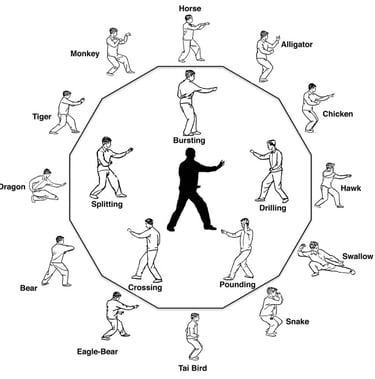
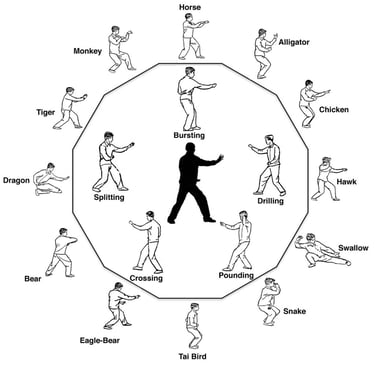
The system of Neidan Shu is taught in modules, each of which includes individual principles of the martial art, its foundations and techniques, combat applications, and specialized exercises specific to a given style. This example includes specialized martial qigong, which takes into account the body's characteristics and creates energy flows that are characteristic of the style. For example, qigong for Tai Chi differs significantly from qigong for Bagua, for example, because the two styles have different structures and differ in training and combat application.
Each modular system represents a simplified or simplified form of the full or traditional version of an internal martial style. However, this does not mean that the "simplified" or "lighter" version is in any way inferior to the long traditional version in terms of effectiveness. It means, first and foremost, that the modernized version presents all the techniques and methods that give the style its strength and effectiveness, and this is important to remember.
Furthermore, it must be noted that traditional forms and methods evolved over years and periods, and were also measured against the demands of time, place, and situation. The modern situation differs from that of ancient or medieval times and, first and foremost, demands good health, strength, and awareness. The phrase "combat effectiveness" has been slightly modified. This means that the technical means exclude combat techniques that inevitably lead to defeat or traumatic bodily injury, which was an absolute necessity in that distant era when knowledge of such techniques on the battlefield was tantamount to a good chance of staying alive or avoiding serious injury. In the modern version, the primary emphasis is on the self-defense apparatus, preventing aggression or neutralizing it by turning it against itself, working on joints and pressure points.
Write your text here...What makes a style effective? In fact, there's no such thing as an effective or ineffective style. Everything depends on the practitioner, their physical, mental, and neuroenergetic abilities. The most effective style may prove powerless against a mediocre fighter. On the other hand, a person with a limited repertoire of a few simple techniques can be invincible. Where does the secret to power and invincibility lie? First, it lies in the acquisition of a specific strength, developed through static and dynamic martial qigong exercises. Second, it lies in the training of a special spiral force called the "silkworm technique," which enables the instant release of accumulated qi energy through the refinement of the nervous system and the increased permeability of neurosynapses. Both types of strength are considered non-muscular; their conductors are not muscles, but tendons and energy meridians.
The development of physical strength, flexibility, and the strength and durability of joints and the spine is achieved through the practice of the Taoist joint gymnastics "12 Gifts of the Tao." The technique of gymnastics, essentially athletic gymnastics without equipment, is based on the techniques of internal styles and dramatically (2-3 times) increases specific physical strength, ensures the harmonious development of all body systems, creates a manifold reserve of health and strength, and provides a foundation for further development. This gymnastics provides a kind of strength that has long been lost by humanity in the modern world.